Menu
Thoughts on ClioCon 2026
November 13th, 2026
Contributor: Brendan Chard
A few weeks ago Erin and I attended ClioCon 2026, in Boston for the second year running. It continues to be one of my favorite conferences because it attracts an audience of attorneys and firm staff that are eager to improve and grow their businesses. That's a different energy than attendees looking to gain just CLE credits and legal knowledge. They also have a doggie petting station so that really resonates with us and our MVPs.

At last year’s conference the overriding message was abundantly clear that AI in legal was not a passing fad, it was going to fundamentally change and challenge the way that lawyers work. This year, between the keynote speakers, demonstrations and Clio product announcements, AI continued to dominate the conversation. But the message shifted from “AI may do” to “AI is doing,” and the firms having AI do the right things are working better, delivering superior service, and earning more. Of course, at the center of it all is the Clio product suite.
What Clio Announced
During his 95-minute opening keynote, CEO Jack Newton shared a slew of company and product updates. The updates we think matter the most to our clients are listed below, but you can view the whole list on Clio.
Unified Platform: Beginning in November, Clio Grow, Clio Manage and Clio Work, the pillars of Clio, are moving into a single unified interface with a consistent navigation and a unified inbox that puts communications into one place. It also adds a “Today” view that shows what needs attention first across the product suite. Clio Grow is also coming to the mobile app, along with meeting recording, transcripts, and AI summaries attached to the relevant matter.. This update should remove the clunkiness and confusing navigation changes that have existed when switching between Clio services.
Clio Grow AI: Grow AI is a new feature to help automate new client acquisition by automating the intake process with AI. It can answer phone calls, text messages, and website chats, qualify potential clients, and move them into the Clio Grow lead pipeline. Clio charges on a pay-per-hire basis for this service, so firms are only charged if the AI-acquired lead hires the firm. In the early going, we see firms implementing this as an after-hours alternative to voicemail.
Ask Clio AI Assistant: Coming with the new unified platform is “Ask Clio,” an AI assistant that exists throughout the Clio AI experience. You can prompt it for updates on existing matters and leads or give it multi-step instructions such as document review and summary. This sort of deep contextual querying is super helpful for knowing where things stand without having to click through to particular matters.
AI-Driven Automations: You can now build automations and workflows using a plain-English prompt. These can then be run on a schedule or be triggered by some event such as automating scheduling when a retainer agreement is signed. This should not only be a time-saver, but will also help firms deliver better client service more consistently.
Clio Phones: Clio now has an entire VoIP phone system as an add-on to the platform and this is really cool. The system allows Clio to automatically tie phone calls with the relevant client and matter in Clio and display the relevant context right on your screen as the call is happening. It’s a softphone, so all calling happens through your computer or mobile device app, no hardware needed, though you can add a compatible VoIP deskphone if desired. It reminded me of the great experience I’ve had ordering a pizza at Domino’s where the worker, based on my caller ID, instantly knows my name, address and order history. Now lawyers can deliver hot and fresh answers more easily.
2026 Legal Trends Report®: This is Clio’s flagship report on the state of the legal practice each year. It’s free, and definitely worth downloading, you just have to share your email address. We’ll do a full post on this later, but here are two points that stand out.
- Promptness matters: When firms followed up within the first 24 hours, the hire rate was 37%, compared with a 29% baseline. That’s 28% more signed clients simply by following up more promptly!
- AI is part of the client journey: Among 1,000 U.S. adults surveyed, 46% would consult AI before turning to a lawyer. Those who would consult AI mostly want to understand their legal issue, research their options, prepare questions for a lawyer, and figure out whether they need one at all. However, when it comes to finding a lawyer, the traditional channels of search, referrals, law firm websites and online reviews still dominate in importance. But 20% say they would consult AI for an attorney recommendation. Of those who hired a lawyer, 6% say that an AI recommendation played a role in their search.
ClioCon by the Numbers: ClioCon had the largest ever attendance with 3,000+ in-person and 8,500 virtual. Clio Work, launched last year, is now used by 10,000 firms worldwide. Impressively, Clio also deploys roughly 1,200 updates a week to their products. Most of these are likely small, behind-the-scenes, tweaks that users won’t notice but it does indicate a rapid pace of continual improvement, which is important for any software company.
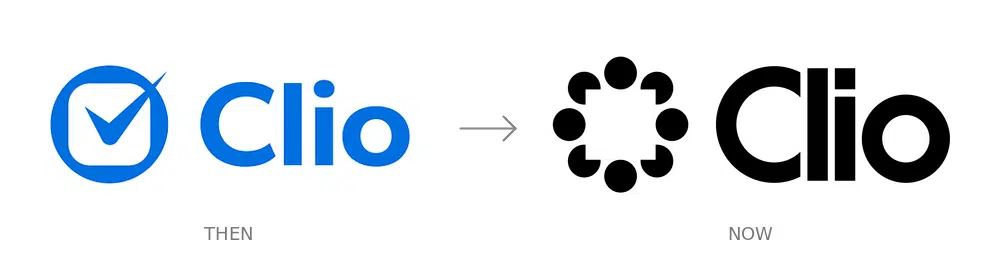
New Clio Logo: As a branding agency for law firms, we love analyzing logos! For the first time in 18 years, the Clio logo has been significantly changed. The old logo was a check mark that doubled as the hands of a clock, signifying both time and a completed task. The logo now presents Clio as a platform with rings around it representing context flowing through an interconnected platform with a view of all in once place. This update moves away from Clio’s more simple origins around to-dos, time and process and now aligns with a larger vision of “context creates capability.”
Keynotes
One of my favorite parts of ClioCon is the world-class people they bring in for their keynotes. This year did not disappoint. Malcolm Gladwell, author of "The Tipping Point" and "Outliers" and host of the Revisionist History podcast, spoke about why good ideas take so long to catch on. Ethan Mollick, a Wharton professor and author of Co-Intelligence, used entertaining live demonstrations to show how quickly AI is changing the way people work. And Mechele Dickerson, a University of Texas law professor and author of The Middle-Class New Deal, closed out the conference by challenging lawyers to help rebuild the middle class.
The two presentations most relevant to our clients’ day-to-day work came from Gladwell and Mollick. Gladwell, as he tends to do, built his talk around research and history, in this case from professions adjacent to law. He showed how police officers and doctors held onto established ways of working even when the evidence clearly favored change. In policing, a community-minded, relationship-driven approach developed in the 1990s has been shown to dramatically lower homicide rates, yet it never became standard practice. In medicine, he pointed to a less invasive off-pump, or “beating-heart,” approach to bypass surgery that, by his account, has outperformed the standard method for decades and still hasn’t caught on. With AI opening up so many ways for legal work to change, he cautioned lawyers against falling into the same all-too-human trap (a fair warning for a profession that, by its own admission, isn’t known for early adoption).
Mollick’s presentation was fast-paced and often comical, a tour of what AI can do today and how it can fit into not just your work but your daily life. His broader challenge to the audience was to take part in shaping where AI goes next. For individuals, he suggested treating AI like an outside team you delegate work to, and writing your instructions the way you would for that team. He also advised being deliberate about what you hand off to AI and what you don’t, and thinking carefully about where the human touch is still needed. That point is especially relevant for law firms as Clio keeps introducing features, like Grow AI’s lead screening and follow-up, that interact directly with clients and prospects. For organizations, he offered three challenges: identify the useful things you used to do that AI has now devalued; identify the things AI makes possible that used to be impossible; and build things that may not work yet but likely will soon, given how fast the technology is improving. None of this works, he said, without three things in place: leadership that embraces it, a willingness to keep experimenting like scientists in a lab, and adoption across the organization.
What I’m Noodling On
The great thing about conferences like this is that you get out of your own bubble and into someone else’s. At ClioCon, that bubble is full of business-minded lawyers who want to do better for themselves and their clients by building firms that will thrive in the years ahead. As the owner of an agency that serves those firms, I see a lot of the same challenges and opportunities in our own business.
AI is the dominant topic now, and it will stay that way for some time. I can’t think of another advancement that has turned so many industries and jobs on their heads so quickly, and all at once. Change can be scary, and this is a lot of change without a clear picture of where it’s headed. But as users, and as citizens, we have a say in how it goes. Standing still isn’t one of the options.
Gladwell closed his talk with a quote from Dr. John Puskas, the surgeon who pioneered the beating-heart bypass technique that, decades later, most surgeons still don’t use:
“There is a reluctance to adopt these things and an eagerness to prove that the old way is still the best way. But, fundamentally, we should not expect that at the end of our career to be operating in the exact way we did when we began our career. Otherwise, we haven’t made any progress.”
I find that a hopeful way to look at what’s in front of us. Some of the things we’ve done that brought real value, and that may even feel like part of who we are, are going to change. Letting go of them is how we get to the next version of ourselves and of what we do.